Artist's Statement
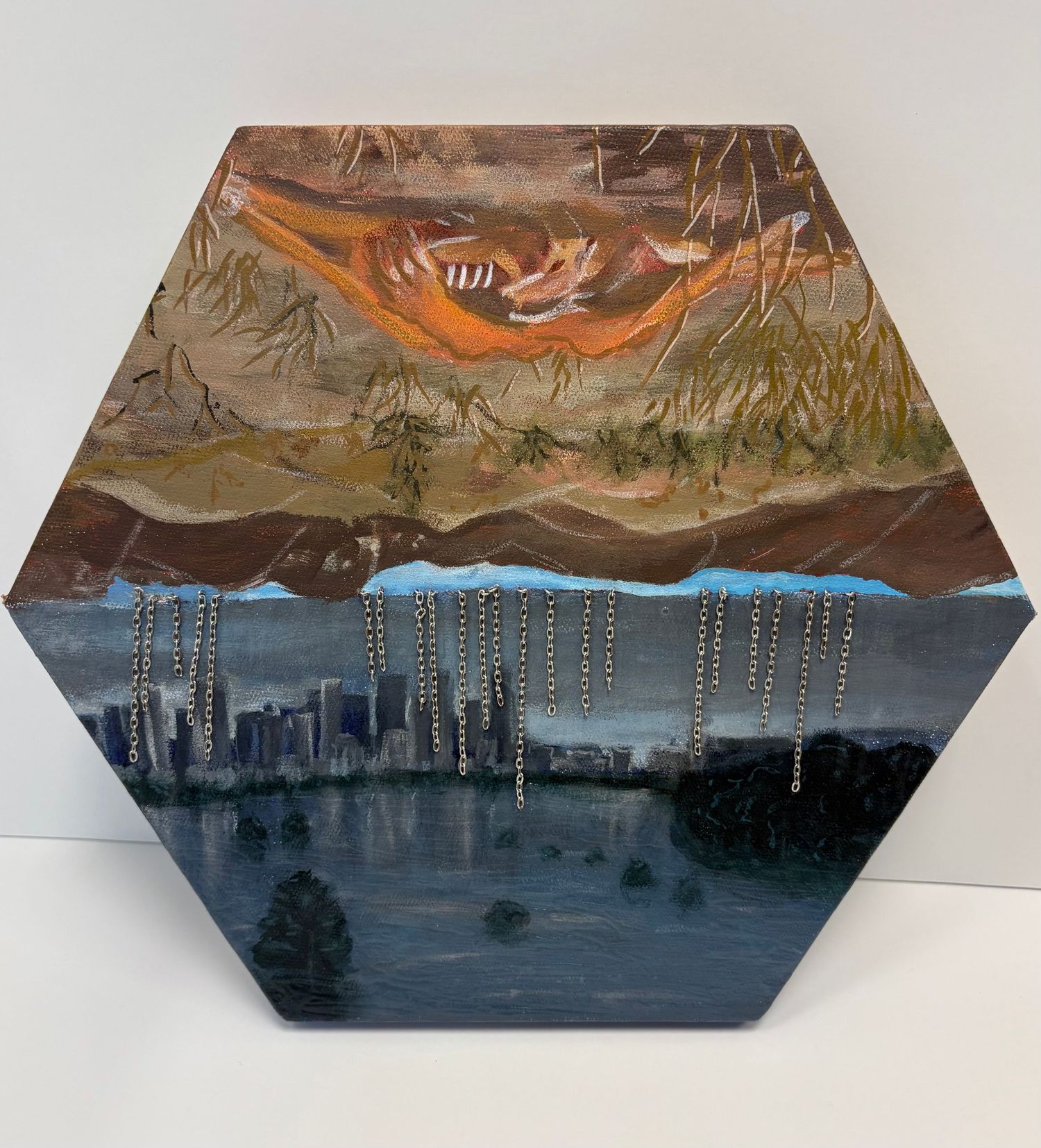
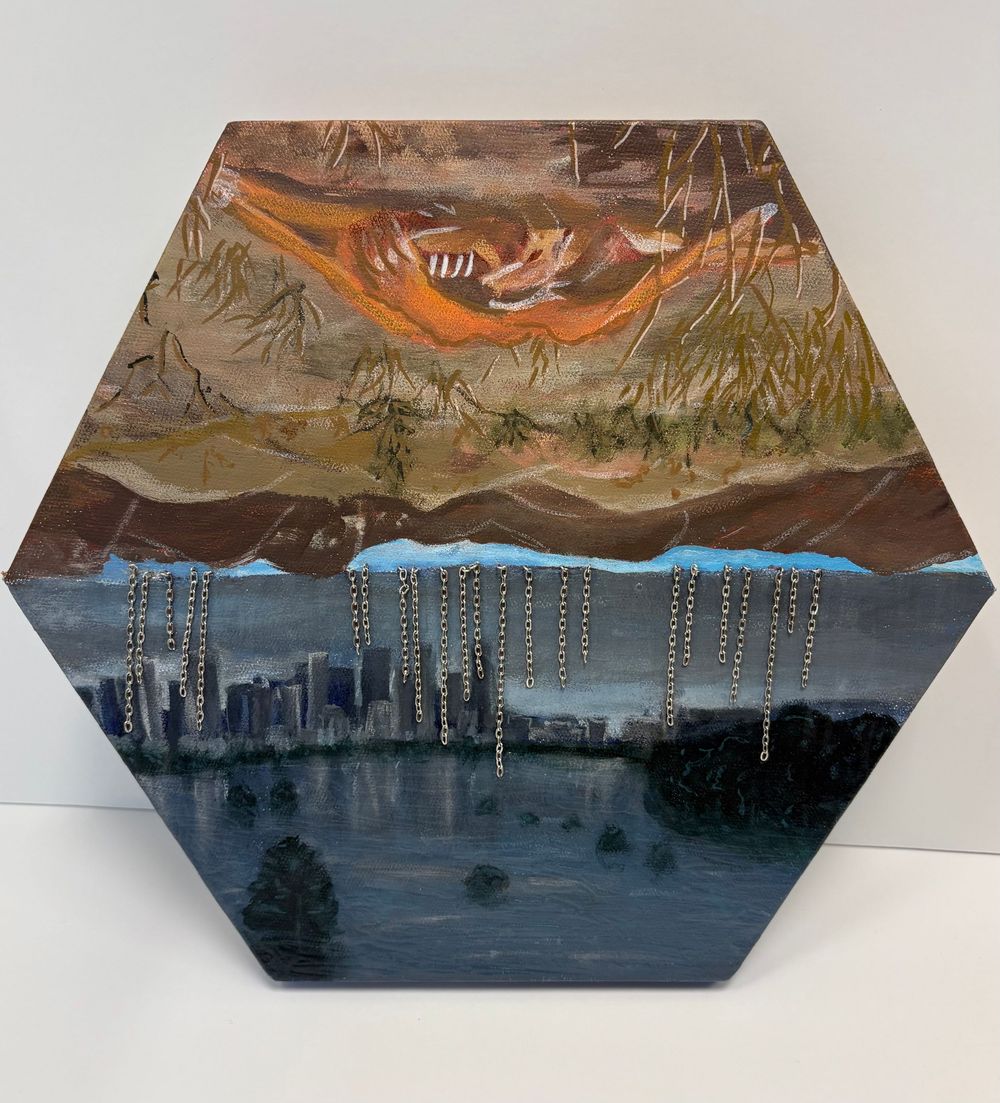
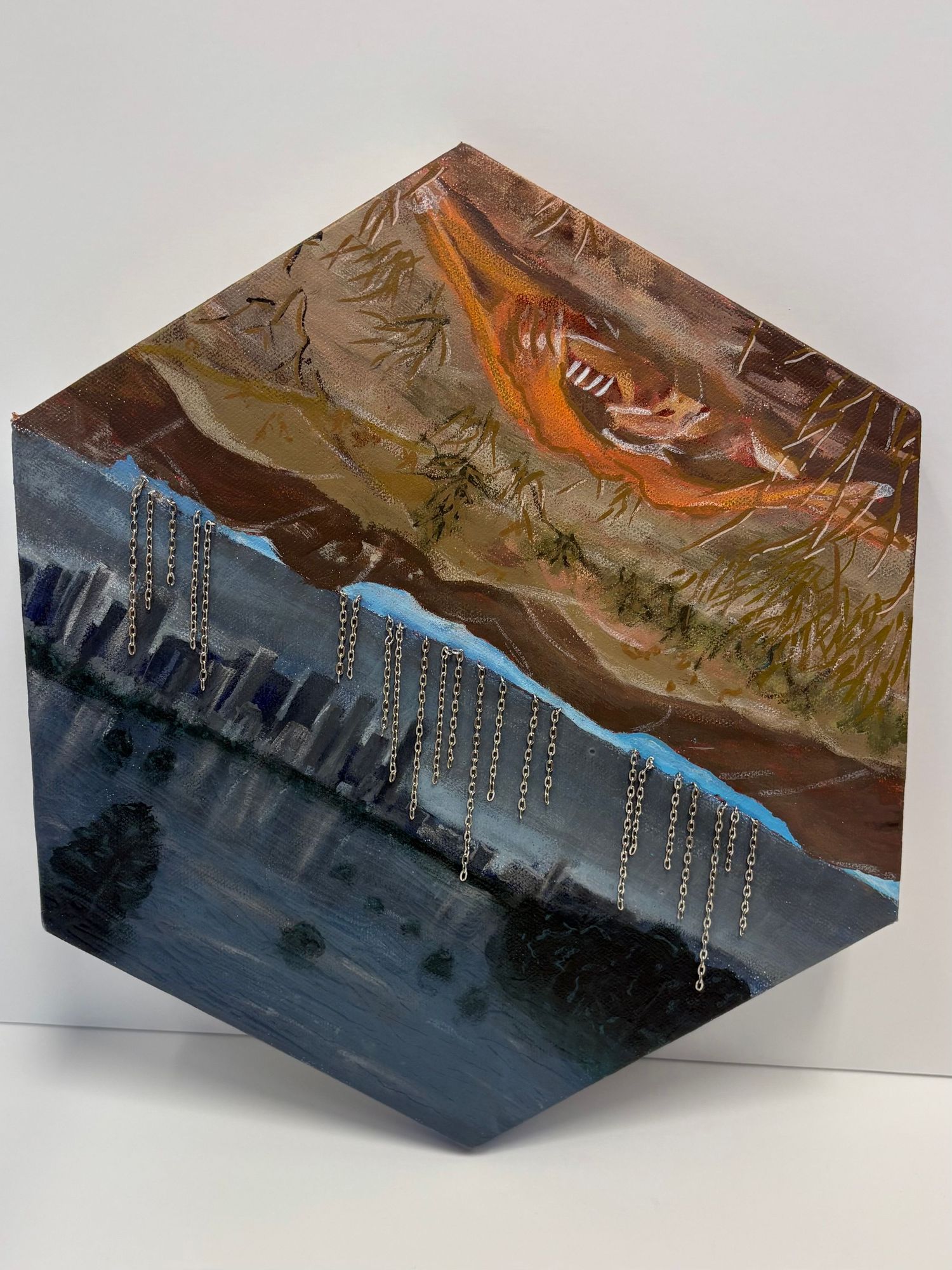
Chain-ge is a multimedia work combining painting and some 3D/tactile elements. The work is acrylic
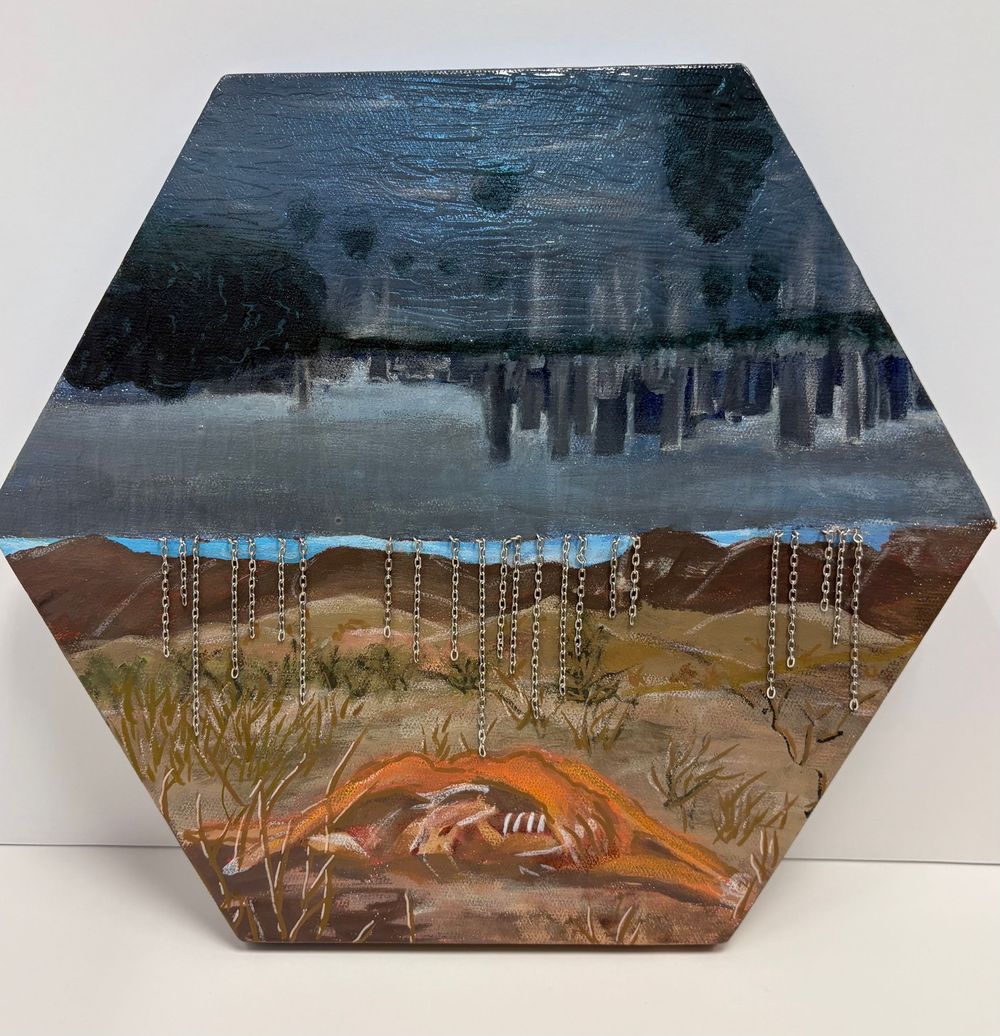
paint on a 1”x11”x11.5” hexagonal canvas, split down the middle to show two disparate landscape images.
One, a flooded city, with treetops peeking above the water and an overcast sky. The other, a desiccated
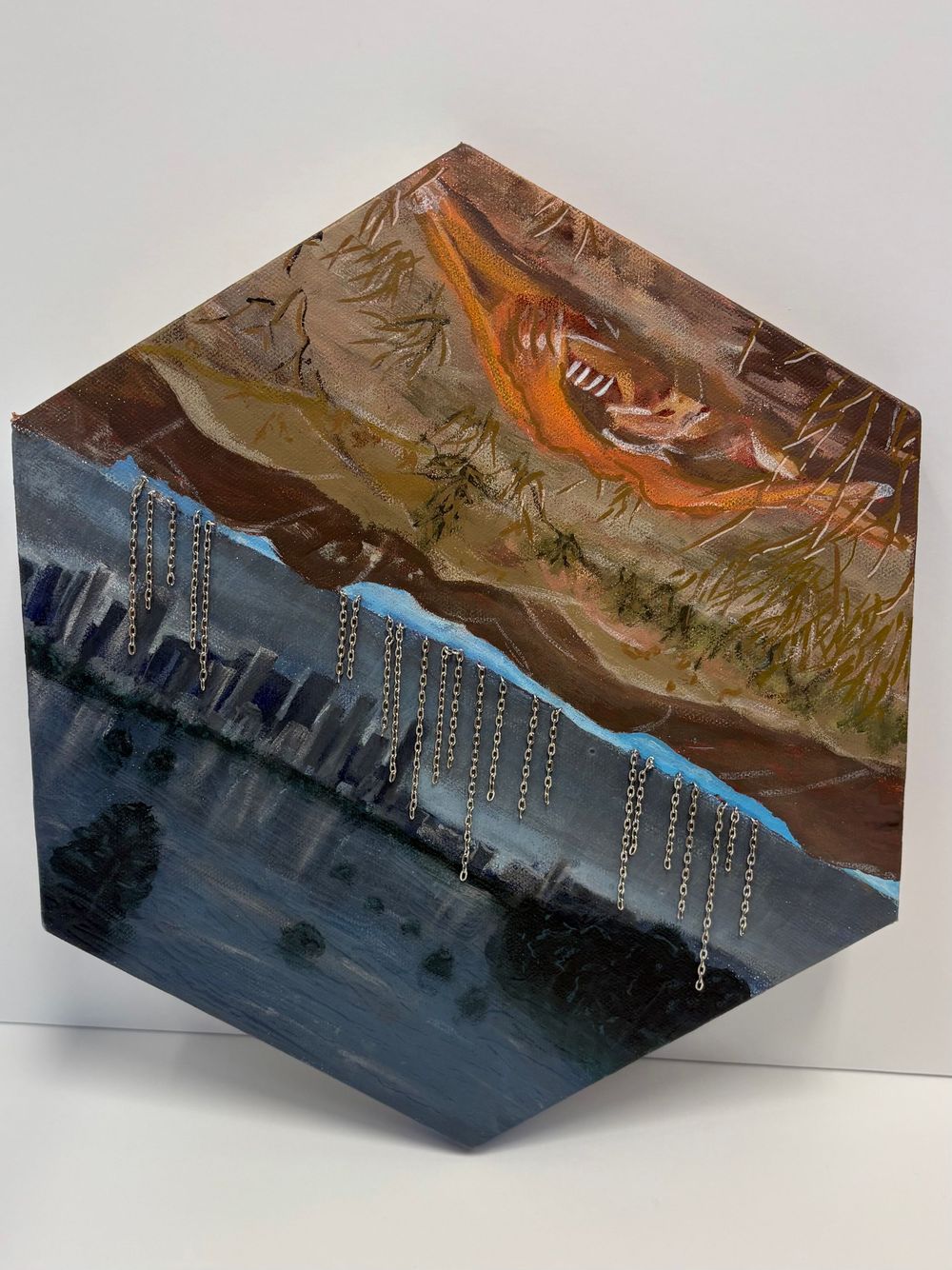
hillside where drought has killed not only the vegetation, but animal life as well, as an emaciated bovine carcass lies at the foreground of the image. Connecting and separating the two images is a line of chains in a variety of lengths, emulating rainfall. Turning the canvas moves the “rain” from one landscape to the other, accompanied by the swishing sounds of chains on canvas which mimic rainfall.
In order to observe both sides of the painting fully, the viewer must turn the work and so their viewing
is necessarily accompanied by the sound of rainfall. The chains also partially obscure the landscapes if they are being viewed right side up, forcing their acknowledgement. They invite the viewer to consider the conditions of the two environments and how rain might affect them. Do the people living in the city want more rain? Do the people in the dry area? At what point does abundance become destructive? Water scarcity and disastrous flooding are just two of the major environmental impacts that humans have had on the Earth in our infinite greed for new things faster and cheaper. Ask yourself, how does your desire for comfort and convenience impact global desire for basic needs, like water?
Photo Documentation
Process of Creating
I started by finding reference images that were inspiring to me (included below) and then took some time to sketch those onto my canvas. I then went over the sketch of each side in a solid base color as a sort of under painting which helps the final work look unified. The city-scape under painting was dark blue, and the desert-scape was red. I then identified where I wanted my chains to hang and poked holes in the canvas with a large safety pin. Using a looping tool (literally called a looper) I made several straight pieces of wire with loops on the end to hang my chain lengths from. I did not have a plan for how long or short I wanted the chains, and "measured with my heart" as I cut the lengths. From there, I secured them to the looped wires with pliers and then stuck them through the pre-made holes. I tried three or four different arrangements of the chain lengths before settling on this one. Then, to hold the wires in place, I slid rubber earring backs over the ends of the wire to secure them. For some reason, I decided to do all of this before painting the final layers of the landscapes, so some of the chains have paint on them. Were I to do this again, I would make the painting fully first before affixing the chains.
IDeation
What subjects are you thinking through?
Time and how time affects objects and people. How things come in and out of fashion. The cyclical nature of human interest and desire. Consumption, over consumption, and how the never-ending quest for more can create both scarcity and overproduction. How the constant seeking of material goods to keep up with the trends has led to major disregard for the Earth and environment, manifesting itself in the severe weather patterns of drought and flooding that we have experienced in recent history.
What ideas came to your mind after being introduced to something new?
The idea to use different finishes (gloss vs matte) to elevate and emphasize environmental differences, and thin color washing to deepen and unify the depth and variety of my color palette in this work were introduced and inspired by the work of Abby Gregg. Additionally, using a foreground image like a car in the city-scape, or adjusting the perspective of the two halves to be more similar were ideas suggested to me to help more concretely link the two halves of the work.
Influences + Inspiration
- Western landscape paintings, especially those exploring more mundane or less idealized beauty of the desert, done by Tine Hayes.
- Multimedia and collage work, particularly utilizing the methods of glazing and combining gloss and matte medium finishes by Abigail Gregg.
- My own use of chains as rain in a prior work.
- Recent global disaster with severe weather phenomenons such as hurricane Helene and the California wildfires.
- The current economic and political climate in America.
Works Cited
Environmental Defense Fund. “Why Are Floods Hitting More Places and People?” Environmental Defense Fund, 2025, www.edf.org/why-are-floods-hitting-more-places-and-people. Accessed 19 Apr. 2025..
The data presented by this website is well sourced and corroborated by several experts in the field, which are named at the bottom of the article.
Gallup New Deal Art. “Tine Hayes, Painter.” Gallup New Deal Art - Virtual Gallery, 22 Jan. 2025, www.gallupnewdealart.org/creative-perspectives/artwork-pairings/tine-hayes-painter/. Accessed 20 Apr. 2025..
Unfortunately, the artist’s website is down at the moment. However, the artist statement and details for the work referenced in this package, as well as an artist’s bio can be found on this museum’s website.
Gregg, Abigail. “ABBY GREGG: Interdisciplinary Artist and Art Educator.” ABBY GREGG, 2016, abbygregg.com/. Accessed 20 Apr. 2025..
Website of Professor Abby Gregg. I have taken two of her classes at Oglethorpe and have seen many of her works in person.
O, Marilyn. “Why You Should Do an Underpainting for Acrylics.” Trembeling Art, 24 May 2021, trembelingart.com/why-you-should-do-an-underpainting-for-acrylics/. Accessed 19 Apr. 2025..
Research on acrylic under painting and how to elevate the final product of a painting.